Affordable Housing Compliance Simplified: A 2026 Guide

Affordable housing compliance is simplified in 2026 by embedding HUD regulatory logic directly into daily property management workflows, replacing disconnected spreadsheets with automated audit readiness. This approach eliminates the manual data entry that traditionally causes reporting errors and ensures that income certifications, asset verifications, and recertifications are processed accurately. By anchoring operations to real-time federal thresholds, property managers reduce staffing pressure and maintain ongoing compliance without relying on periodic reviews.
Property managers across the U.S. are juggling HUD programs, LIHTC layers, staffing shortages, and rising audit scrutiny. They do this while using systems never built for federal compliance. That is why more teams actively search for HUD compliance software instead of generic property management tools. For related operational guidance, review affordable housing compliance software.
This guide does not just re-list regulations. It explains why compliance fails in daily operations. It also shows how modern affordable housing software acts as a risk-management system rather than just a database.
The Hidden Shift in HUD Compliance (That Most Vendors Don’t Talk About)
In the past, HUD compliance was just a periodic reporting exercise:
- File reviews before audits
- Year-end reconciliations
- Last-minute corrections
In 2026, that approach is breaking down.
Guidance from the U.S. Department of Housing and Urban Development increasingly emphasizes:
- Data consistency across tenant files
- Timeliness of certifications and reporting
- Clear traceability of changes, not just final submissions
At the same time:
- Affordable housing operators report persistent understaffing in compliance and onsite roles
- Audit findings are more often tied to process gaps, not misunderstanding regulations
- Knowledge loss from turnover has become a measurable compliance risk
The result: HUD compliance is now a daily operational requirement, not an annual event. This shift explains why search demand for HUD compliance software now beats demand for generic property management systems.
Why HUD Compliance Breaks at the Workflow Level
Most compliance failures don’t happen because teams don’t care. They happen because systems weren’t designed for HUD reality.
Common breakdowns across U.S. portfolios include:
1. Compliance logic lives outside the system
Income limits, rent rules, and eligibility logic often live in spreadsheets, PDFs, or staff memory. Meanwhile, the PMS acts only as a record keeper.
2. Reporting is disconnected from daily actions
Staff often enter data for HUD or TRACS reporting weeks or months before submission. This delay makes errors hard to trace and correct.
3. Staff turnover creates invisible risk
Undocumented workflows leave when experienced compliance staff quit. This creates risk long before the next audit.
HUD-specific affordable housing software changes this equation.
What HUD Compliance Software Does Differently in 2026
Modern affordable housing software is no longer just HUD-compatible. The best platforms are HUD-native by design.
Compliance rules embedded into workflows
The software enforces HUD rules right at the point of action. It does not rely on memory or checklists:
- Income and asset thresholds validated during certification
- Required documentation flagged before file completion
- Rent calculations aligned with HUD and LIHTC rules automatically
This greatly reduces later corrections and audit findings.
Continuous audit readiness
Files stay audit-ready year-round instead of being prepared reactively for HUD reviews:
- Centralized documentation
- Time-stamped changes
- Clear reporting lineage aligned with HUD review practices
This directly supports the HUD focus on data integrity and traceability.
Designed for constrained teams
Research from the National Low Income Housing Coalition shows a clear trend. Staffing capacity, not regulation knowledge, is now a top operational constraint in affordable housing.
Effective HUD compliance software reduces:
- Clicks per task
- Manual data re-entry
- Dependency on “power users”
Core Compliance Pillars in Affordable Housing (2026)
In 2026, affordable housing HUD compliance is anchored in a small set of operational pillars that must be enforced continuously—not reviewed periodically:
- Income Verification
Validate tenant income eligibility at move-in and annually, ensuring households meet required thresholds (typically 50% or 60% of Area Median Income) with traceable documentation and consistent calculation logic. - Rent Restrictions
Set and maintain rents based on AMI limits, automatically enforcing maximum allowable rents across HUD and LIHTC programs to prevent overcharges and downstream audit findings. - Documentation & Audit Readiness
Maintain complete, centralized records for tenant applications, income verification, certifications, and lease terms, with time-stamped changes that align with how HUD auditors review files. - Physical & Inspection Standards
Monitor and maintain properties to meet required inspection standards, including REAC scores, to avoid compliance penalties tied to physical condition rather than tenant eligibility.
Key HUD Compliance Areas Software Must Support
For U.S. operators in 2026, these areas are non-negotiable:
Income Certifications & Recertifications
Missed or wrong certifications remain a top audit risk. Software task queues and deadline logic ensure nothing is missed.
HUD Reporting & Data Consistency
Systems must align operational data with HUD review expectations. They must do more than just export files for TRACS, layered programs, or public housing reporting.
Documentation & File Integrity
Audit findings often stem from missing or inconsistent documentation. Centralized, role-based access controls protect file integrity even when staff change. Industry analysis from Novogradac consistently highlights documentation gaps as a leading source of compliance findings. These gaps are often unrelated to tenant eligibility itself.
In 2026, leading operators view compliance alongside other operational risks. These include staffing gaps, reporting failures, and delinquency risk. These risks are highlighted in broader delinquency & operational risk insights.
Choosing HUD Compliance Software: A Smarter Evaluation Lens
Stronger operators no longer just ask “Does this system support HUD?”. They now ask:
- Does HUD logic guide staff during daily work?
- Can a new hire follow compliance workflows without tribal knowledge?
- Does reporting reflect how auditors actually review files?
- Does the system reduce operational risk under staffing pressure?
The best affordable housing software removes guesswork from execution.
How ExactEstate Solves HUD Compliance
ExactEstate treats HUD compliance as an operational system, not just a reporting task. Its affordable housing software embeds HUD and LIHTC rules directly into daily workflows. It validates income, documentation, rent, and certifications at the point of execution. This makes compliance happen by default, even under staffing pressure. ExactEstate reduces clicks and guides staff through program-specific tasks. It maintains continuously audit-ready files with clear data traceability. This helps teams minimize errors, avoid last-minute corrections, and stay compliant year-round without relying on institutional knowledge.
ExactEstate embeds HUD and LIHTC rules directly into daily tasks. It uses purpose-built HUD & LIHTC compliance workflows to validate income, documentation, and certifications at the point of execution.
ExactEstate vs. Generic HUD Tools
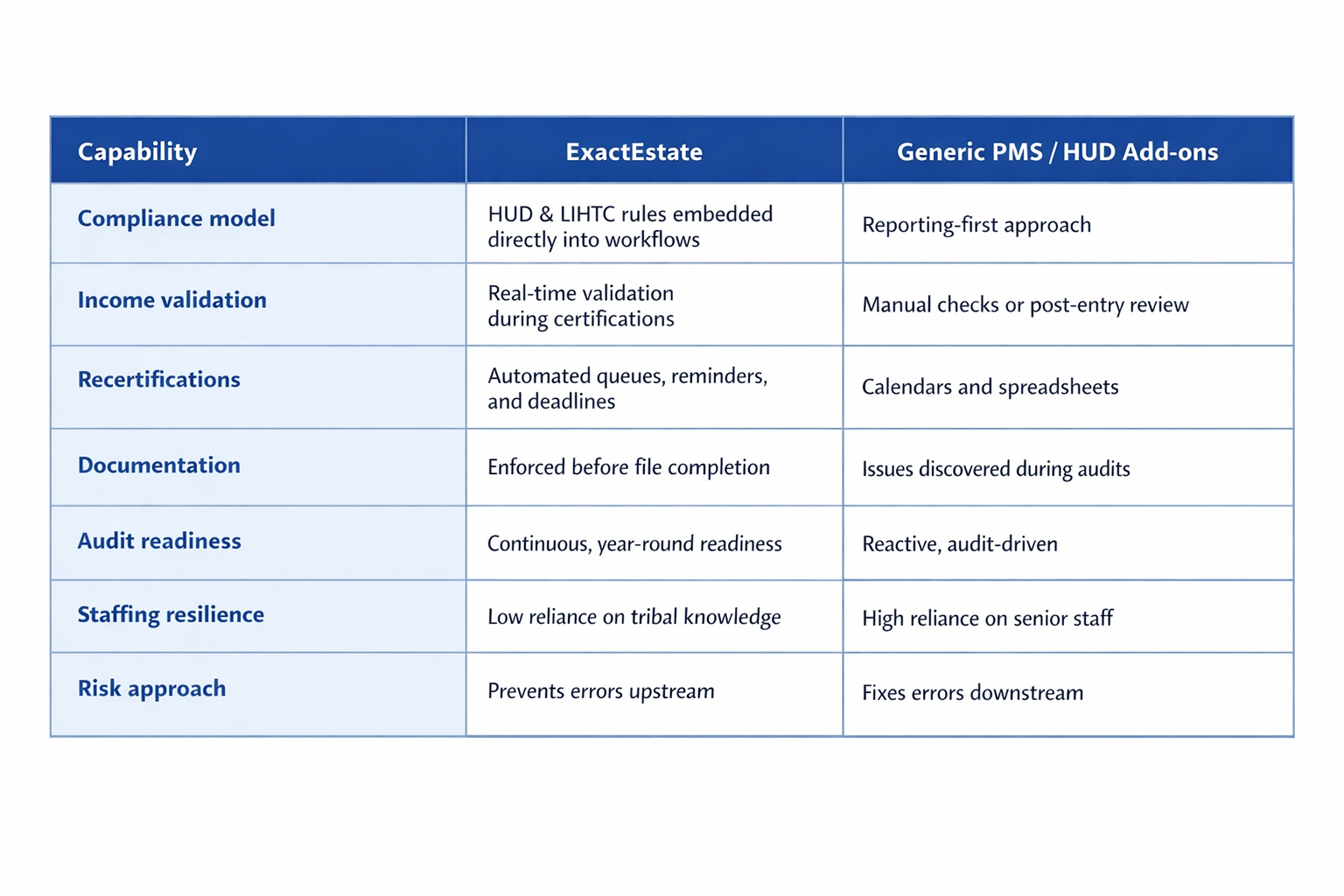
Bottom line: Most competitors help teams report on HUD compliance. ExactEstate helps teams execute compliance correctly by default. This reduces audit findings, operational risk, and staff burnout in real-world, understaffed environments.
Compliance Simplified
Affordable housing compliance is not getting simpler. But it is becoming more system-driven.
HUD compliance software built for affordable housing is no longer optional for U.S. operators. It is how teams move from reactive reporting to predictable, defensible compliance.
That is the real shift in 2026. It is why affordable housing software is now a core operational safeguard, not just a back-office tool.
How does compliance software mitigate staff turnover risks?
The software embeds compliance rules directly into daily workflows. This ensures new team members follow the correct procedures from day one. It reduces the hidden risk created by frequent staff changes.
What makes ExactEstate different from generic HUD compliance tools?
Generic tools often treat compliance as an afterthought. ExactEstate embeds compliance logic directly into daily workflows and reporting. This ensures continuous audit readiness specifically designed for constrained teams.
Core Federal Thresholds in Affordable Housing
Modern compliance software must automatically enforce specific federal thresholds during income and asset calculations to maintain continuous audit readiness.
When calculating very low-income limits, systems must reference 24 CFR 5.603, which states: “or (2) Thirty (30) percent of the median income for the area, as determined by HUD, with adjustments for smaller and larger families, except that HUD may establish income ceilings higher or lower than 30 percent of the area median income for the area if HUD finds that such variations are necessary because of unusually high or low family incomes.” (https://www.ecfr.gov/current/title-24/section-5.603)
For asset evaluations, compliance requires flagging families when 24 CFR 5.618 dictates: “(i) The family's net assets (as defined in § 5.603) exceed $100,000, which amount will be adjusted annually by HUD in accordance with the Consumer Price Index for Urban Wage Earners and Clerical Workers;” (https://www.ecfr.gov/current/title-24/section-5.618)
Furthermore, dependent deductions must align with 24 CFR 5.611, which mandates: “(1) $480 for each dependent, which amount will be adjusted by HUD annually in accordance with the Consumer Price Index for Urban Wage Earners and Clerical Workers, rounded to the next lowest multiple of $25;” (https://www.ecfr.gov/current/title-24/section-5.611)
Sources
- 24 CFR 5.603 — the regulation text — Electronic Code of Federal Regulations
- 24 CFR 5.611 — the regulation text — Electronic Code of Federal Regulations
- 24 CFR 5.618 — the regulation text — Electronic Code of Federal Regulations
What changed
- — 4 cited figure(s) match the current regulation text
- — 4 cited figure(s) match the current regulation text