Upgrading Property Management: Modern Accounting Systems
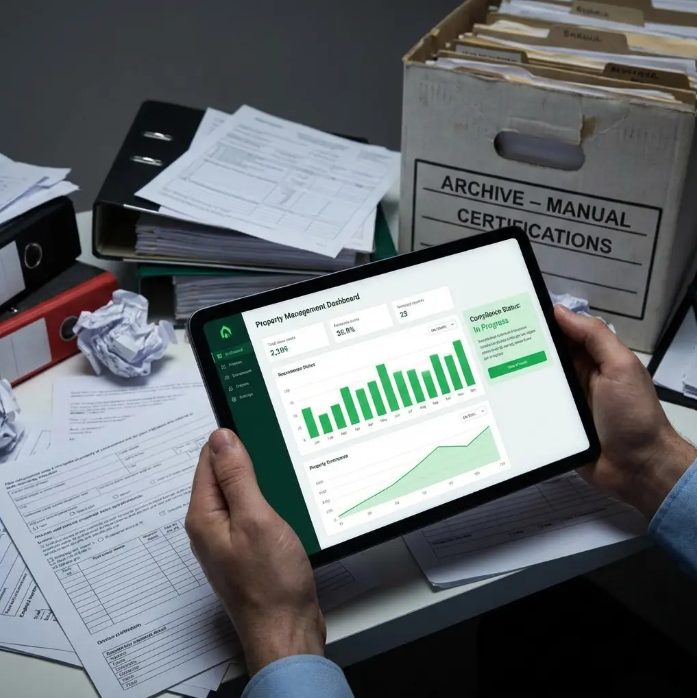
Upgrading your property management system is more than moving data to the cloud. You must rethink how you handle accounting, compliance, and daily operations. Many operators fall into the digitization trap. They simply copy broken manual workflows into modern software. To truly modernize, your new system must enforce real-time accounting, HOTMA, and TRACS compliance. It should not just store the results.
Property management companies still running manual processes face heavy pressure to modernize. But most upgrades fail. This is not because the technology is bad. It happens because they digitize broken workflows instead of fixing them. For related operational guidance, review property accounting software.
83% of data migration projects fail or go far over budget and time, according to Gartner research. 85% of enterprises completed migrations in the past two years. Yet only 25% got the expected value in the first year.
Moving from manual to modern is not about adding features. It is about whether the system runs your operations, or your staff does.
Why Manual Systems Break Down
Manual property management relies on spreadsheets, paper files, phone calls, and memory. Every recertification becomes a data entry marathon. Compliance tracking lives in many documents. Rent calculations happen outside the system. Staff must enter them by hand.
The breaking points are easy to predict. You see missed deadlines, calculation errors, and audit findings. You also see staff turnover that takes critical knowledge away.
But when companies upgrade, they often ask the wrong question:
"Does it have this feature?" instead of "What does this prevent?"
The Digitization Trap: When Modern Software Runs Manual Processes
Most upgrades do not fail because of the technology. They fail because companies copy their manual workflows into digital form.
A mid-sized affordable housing operator ran everything by hand. They did recerts in spreadsheets. They double-checked income calculations outside any system. They corrected rent adjustments by hand. They reconciled accounting at month-end.
They upgraded to modern software. Six months later, nothing improved. They had just digitized their manual process.
Manual approach: spreadsheet tracking, external calculations, manual corrections, after-the-fact reconciliation.
"Modern" approach: same spreadsheets uploaded as attachments. Same external calculations "to be safe." Same manual corrections. Same reconciliation timing.
The workflow did not change. The system did not enforce compliance logic. It just stored manual work faster. The breaking point came during a Management and Occupancy Review. Minor gaps between income fields and EIV documentation triggered the findings. The new software allowed overrides without enforcing HOTMA logic. It did not check differences before certification. It did not flag timing gaps in TRACS submissions.
Staff still had to remember compliance rules. This meant the system was not running the operation.
What Modern Actually Means
True modernization removes manual work. It does this by putting compliance logic, validation rules, and workflow controls right into the system.
Modern does not mean digital interfaces.
It means:
- Income calculations that enforce HOTMA logic automatically—no manual verification needed
- Certification processes that block submission when documentation is incomplete
- Accounting that stays synchronized with compliance in real time—no month-end reconciliation
- TRACS submissions validated before they leave the system—no rejected files
If your staff must remember compliance rules, you have not modernized. You have just digitized manual work.
Three Questions That Expose Feature Theater
You need to know if a system actually runs your operations. Ask these three specific questions during the demo.
Question 1: "What happens if I try to finalize a certification with incorrect or incomplete income documentation?"
Then stop talking. Learn why property management teams are switching to ExactEstate. Every system can make a 50059. Every system can calculate income. The real issue is enforcement.
You want to see:
- Does the system block finalization?
- Does it flag the specific discrepancy?
- Does it require EIV alignment?
- Does it log the override?
- Or does it simply allow submission?
The vendor might say, "Well, the user should double-check that." That is feature theater. A modern system enforces compliance before submission. It does not wait until after rejection.
Question 2: "Can accounting close the month if certifications are incomplete or out of sync?"
This question shows if compliance and accounting are truly linked. In many platforms, compliance lives in one module. Accounting lives in another. Reconciliation happens by hand.
The month-end might close while certifications are incomplete. If so, the system is not running the operation.
You want to see if the system flags certification gaps. It should tie subsidy amounts right to certification status. It should give real-time reconciliation between compliance and the ledger. If the demo avoids this, that is your signal. Modernization means financial data automatically shows compliance status.
Question 3: "Show me what happens when something goes wrong—not when everything goes right."
Be specific. Ask about mid-cycle income changes. Ask about late EIV documentation, TRACS rejections, HOTMA rule adjustments, and wrong rent overrides.
Most demos show perfect workflows. You want to see how the system finds errors. Does it stop submission? Does it auto-correct logic? Does it log risk exposure? Does the workflow adapt?
The rep might say, "That rarely happens." But it happens every week in real portfolios. Real enforcement systems are built for edge cases. Feature theater systems are built for happy paths.
The 300% Implementation Underestimation
Vendors often promise "two-week implementations." They just mean data transfer. They do not mean operational stabilization.
Research shows only 15% of enterprises finish migrations on time and on budget. Meanwhile, 55% experience significant delays or cost overruns. Groups face an average annual cost overrun of 14% on migrations. Enterprises always underestimate costs by millions in unplanned expenses.
Week 1: Data imported, property structure set up, permissions assigned.
Week 2: Training, test transactions, go-live. On paper, it looks successful. But what has not been tested is far more important than what has.
Data Was Moved—Not Validated
Most migrations focus on field mapping. They skip validating certification status, HOTMA alignment, 50059 integrity, EIV consistency, or ledger reconciliation. Systems look fine until the first recert cycle. Month two exposes old errors imported without fixes.
The Happy Path Was Tested—Not the Edge Cases
Vendors test clean move-ins and standard recerts. They do not test mid-cycle income changes, TRACS timing conflicts, late EIV documentation, or retroactive corrections. Edge cases arise under pressure. This is when staff realize the system just allows things instead of enforcing rules.
Accounting and Compliance Were Never Truly Reconciled
Accounting and compliance are technically linked but operationally separate. By month two, certification updates do not match subsidy receivables. Rent overrides do not flow cleanly. Adjustments require manual journal entries.
TRACS and Payment Risk Don't Surface Immediately
TRACS cycles create delayed feedback. Issues show up during rejected voucher cycles, delayed HAP payments, or MOR findings. This happens after vendors consider the work complete.
Vendors estimate data migration, configuration, and training. What they do not estimate is operational governance, compliance validation, and workflow reinforcement.
The Hidden Compliance Reality
According to industry data, the late release of TRACS 203A forced property managers to use manual calculations and rent overrides. They digitized incomplete processes using workarounds.
MORs completed during 2024 listed HOTMA deficiencies as observations. After January 1, 2025, they became findings in MOR reports. Problems surface 30–60 days after go-live. Systems look fine until real-world pressure testing occurs.
What Modernization Actually Requires
A true property management system upgrade should remove the need for staff to fix software gaps.
A recert might be finalized while income logic clashes with HOTMA. That is not modernization. Accounting might close the month while certifications are incomplete. Then the system is not connected. Digitizing a broken workflow just makes errors faster.
Modernization means putting control right at the point of action. The system must enforce income logic before certification. It must enforce TRACS validation before submission. It must do real-time accounting reconciliation. It must require certification completion before voucher generation. Then the operation becomes stable. It does not depend on memory.
A structured migration should include:
- Certification validation before data import
- Income logic testing aligned with HOTMA
- TRACS sample submission testing
- Accounting-to-certification reconciliation
- Parallel workflow rehearsal
- Post-go-live monitoring period
Modernization is not about flipping a switch. It is about taking back structural control. The implementation might end the day the system turns on. Then it was not an implementation. It was just a handoff.
The Real Evaluation Framework
Most companies think they are buying better tools. What they actually need is structural governance. The real question is not "How does this look?" It is "What does this prevent?"
At ExactEstate, we tell property managers a simple rule. If your team must remember compliance rules, your system is not enforcing them. A modern platform does more than give you tools. It stops errors before they happen. That is the difference between a software upgrade and an operational reset.
The platform should run the operation, not your staff.
Stop fighting your software. Start managing properties.
Are you evaluating a property management system upgrade? Focus on operational control rather than feature lists. Ask the three questions that expose feature theater. Demand to see error scenarios, not just happy paths. Make sure the vendor's timeline includes stabilization, not just installation.
The difference between digitizing a broken process and modernizing it is simple. A modern system stops you from making the mistake. A feature-heavy system assumes you will not.
That is the gap nobody is talking about. See Why Teams Choose ExactEstate.
What changed
- — no regulatory figure is stated, so nothing to contradict
- — no regulatory figure is stated, so nothing to contradict
About the author

Matt Hoskins is the CEO of ExactEstate. He grew up in his family’s affordable housing management company and has spent his career on the operator side of LIHTC, HUD and Section 8 properties. ExactEstate is the result: compliance-first property management software for affordable housing, with TRACS submission built in.