2026 NSPIRE Checklist for HUD Properties

To prepare for a 2026 NSPIRE inspection, HUD-assisted properties must complete a 90-day self-inspection runway, clear all work order backlogs, and verify life-safety systems across the three inspectable areas: the unit, the inside common areas, and the outside property. By targeting the four severity tiers and organizing required compliance documentation before the inspector arrives, property managers can resolve critical deficiencies early and avoid failing scores.
Your inspector is closer than you think.
HUD's new physical inspection protocol — NSPIRE — has been live for public housing since July 2023 and for HUD-assisted multifamily since October 2023. The phase-in period is over. The non-scored grace window for the new affirmative requirements expired in October 2025. Inspectors are out in the field today, and the properties getting hit hardest are the ones still preparing as they did for UPCS.
That doesn't work anymore. NSPIRE moved the goalposts. The cosmetic stuff that used to drive your UPCS score barely registers now. What does register: anything that threatens resident health and safety inside an occupied unit. Which is exactly where most properties have the least visibility.
This is the prep playbook our team uses with affordable housing operators heading into a HUD inspection. Read it once, run the checklists with your maintenance lead, and you'll know exactly where your portfolio stands before HUD does.
What Actually Changed With NSPIRE
The short version: HUD threw out two old standards (UPCS for multifamily/public housing and HQS for vouchers) and replaced them with a single unified inspection model. The model is structured around three things you need to internalize.
1. Three inspectable areas, not five
Everything in the property now falls into one of three buckets:
- Unit. The dwelling unit where a HUD-assisted resident lives. This is where NSPIRE puts the most weight.
- Inside. Common areas and non-residential interiors — corridors, community rooms, mechanical rooms, stairwells.
- Outside. The exterior — building envelope, walking surfaces, parking, site lighting, fences, and grounds.
2. Four severity tiers, not a flat checklist
Every deficiency is now rated as Life-Threatening, Severe, Moderate, or Low. The rating drives both your point deduction and your correction timeline.
3. A scoring system designed to fail properties that fail residents
Public housing and multifamily properties still get a 0–100 score. But two failure thresholds now exist:
- Property Threshold: Below 60 points overall is a fail.
- Unit Threshold: Even if your overall score is above 60, you fail if 30 or more points were deducted from in-unit deficiencies.
That second one is the trap. You can have pristine grounds, immaculate common areas, a brand-new lobby — and still fail if your occupied units have stacked-up health and safety problems. HCV and PBV inspections remain pass/fail (no numerical score), but the standards and correction timelines apply the same way.
And below 30? That's an automatic referral to HUD's Departmental Enforcement Center. You don't want that conversation.
The Severity Tiers and Your Correction Clock
Memorize this table. The clock starts when you receive notification, which usually means the end of the inspection day, when the inspector hands you the Health and Safety Report listing every Life-Threatening and Severe deficiency identified.
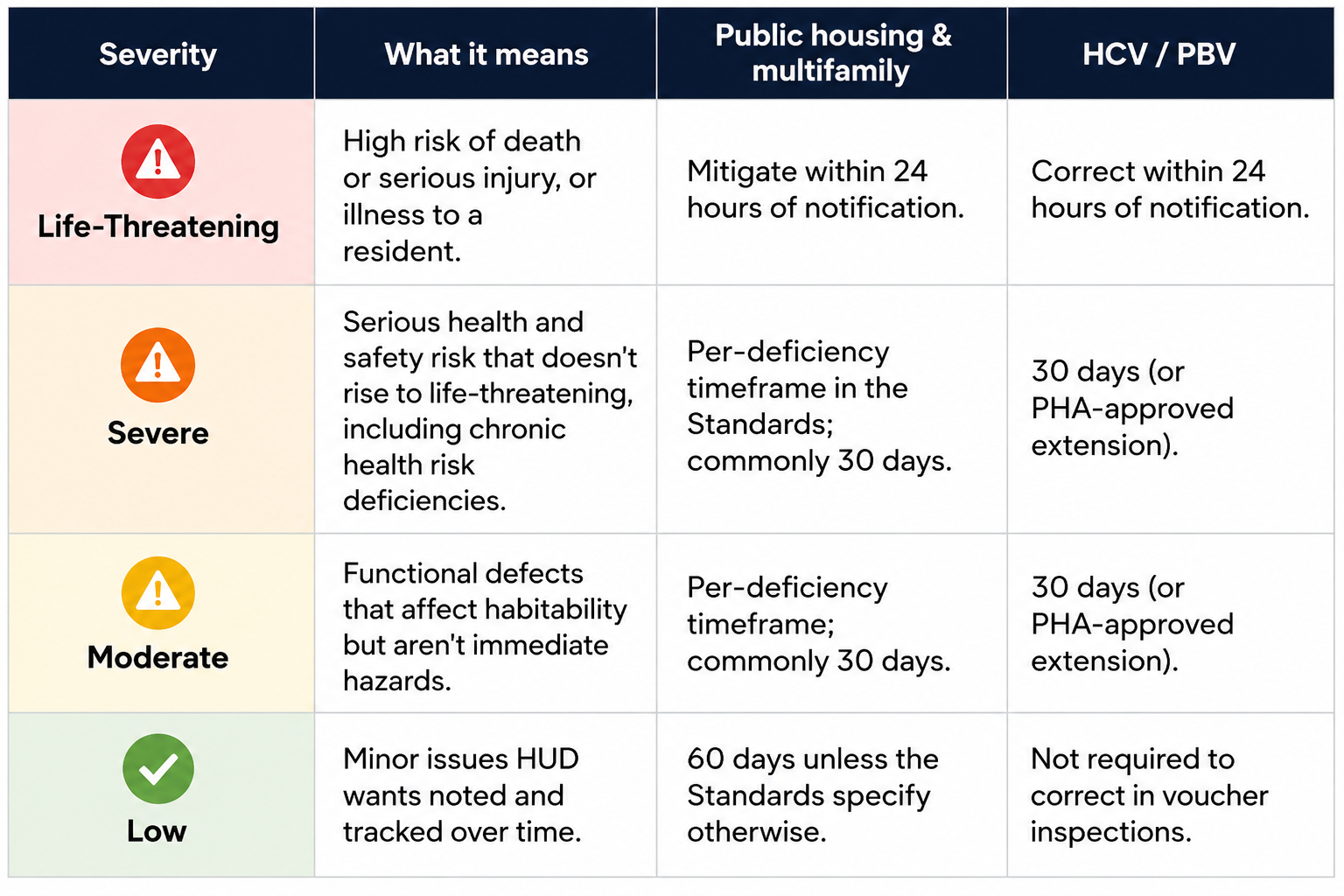
A few things to flag: the Standards specify per-deficiency correction timeframes, so don't treat "30 days" as gospel for every Severe item — check the Standard. And HUD permits temporary relocation of residents when repairs can't be completed within the required window.
Two scoring quirks worth knowing. Smoke alarm defects don't get scored — they get flagged with an asterisk (*) after your overall score. Carbon monoxide alarm defects are flagged with a plus sign (+) and must be corrected within 24 hours. Neither one directly tanks your score, but both signal to HUD that something basic is broken.
Pre-Inspection Prep: Your 90-Day Runway
HUD generally gives you 14 days' notice before an inspection. That's not enough time to find and fix systemic issues — it's barely enough time to do a good walk-through. Your real prep window is the 90 days before that notice arrives.
90 Days Out: Portfolio-Wide Self-Inspection
PHAs and POAs are required to conduct annual self-inspections of every unit anyway. Use that requirement as your NSPIRE dry run. Walk every unit. Document every finding. Categorize by severity. Issue work orders against everything that wouldn't pass an inspector's eye.
60 Days Out: Clear the Work Order Backlog
The 60-day preparation window is the make-or-break interval. Pull every open maintenance work order tied to a unit, common area, or building system. If it's a Life-Threatening or Severe item — already there in your records, already documented as known — and you haven't closed it, you're not just losing inspection points. You're losing the technical-review argument that you didn't know about it.
30 Days Out: Targeted Remediation
- Re-walk every unit that had a finding within the past 60 days. Verify the fix actually held.
- Run a fresh battery and operability check on every smoke alarm and CO detector in the portfolio. Document the test date.
- Test GFCI receptacles in every kitchen, bathroom, garage, and exterior outlet. Replace any that don't trip.
- Verify hot water at every fixture is between 110°F and 125°F.
- Confirm heat works in every habitable room. (This sounds obvious. It is not always true.)
- Check that every fire-labeled door is intact, undamaged, and self-closing.
14 Days Out: Notification Arrives
- Notify residents per your tenant participation policy.
- Pull and organize your documentation file (more on this below).
- Brief your maintenance team on inspector behavior and 24-hour mitigation expectations.
- Make sure someone authorized to make decisions is on-site every day of the inspection.
Day Before
- Print and distribute a paper copy of unit access notes — including any units flagged for resident-requested inspection.
- Stage materials for likely 24-hour fixes: GFCI receptacles, smoke and CO detectors with fresh batteries, common fixture replacement parts, sealants, and anti-tip kits.
- Confirm any resident temporary relocation plan you might need to execute on findings that can't be fixed on the same day.
The Unit Checklist (Where Most Points Die)
Units carry the most weight in NSPIRE scoring. Get the unit right, and you've solved most of your exposure. Most operators don't get the unit right — not because they don't try, but because their visibility into 200, 500, 2,000 occupied units is mediated by maintenance staff and resident calls. Things slip.
Learn more about the unit checklist for property managers.
Life-Safety Systems
- Smoke alarms present, properly mounted, audible test, batteries fresh. Flagged with * if defective.
- Carbon monoxide alarms are present in any unit with fuel-burning appliances or an attached garage. Working, properly placed, batteries fresh. 24-hour fix required if defective.
- Fire-labeled doors intact, undamaged, self-closing, latching. The new affirmative requirement is now in scoring.
- Egress windows and doors operate without tools, special knowledge, or excessive force. Bedroom egress is a Life-Threatening fail if blocked.
Electrical
- GFCI protection on receptacles in kitchens, bathrooms, garages, exterior outlets, and within 6 feet of any sink.
- AFCI protection on circuits per NSPIRE Standards (this is among the new affirmatives now in scoring).
- No exposed wiring, missing cover plates, scorched receptacles, or three-prong outlets without ground.
- Service panel labeled, accessible, and with no double-tapped breakers.
Plumbing & Water
- Hot water between 110°F and 125°F at the most distant fixture from the heater.
- No active leaks at supply lines, drains, P-traps, water heater, or fixtures.
- No standing water under sinks (cabinet bottoms not warped, no biofilm).
- Toilets flush, refill, and seal without rocking.
- Tub and shower drains clear; surrounds intact and sealed.
Heating, Cooling, Ventilation
- Heat operable in every habitable room — verify by running it, not by trusting the thermostat.
- HVAC unit accessible for service; no obstructed condensate drains.
- Filters changed within the last 90 days (document this).
- Bathroom ventilation operable; range hood operable.
- No combustion appliance in a sleeping room without proper venting.
Mold, Moisture, Pests
- No visible mold-like substances above a contiguous 5 square feet (Severe) or below that threshold (Moderate).
- No active leaks, water staining, or sustained moisture in walls, ceilings, or under sinks.
- No evidence of active infestation: droppings, harborage, live insects.
- Pest management plan documentation available (start date, schedule, treatment records).
Fall, Trip, Sharp-Edge Hazards
- Handrails on stairs of 4+ risers; properly anchored, full length.
- Guardrails on any walking surface 30+ inches above grade — meeting height and infill requirements.
- No tripping hazards on walking surfaces (lifted flooring, raised transitions, displaced thresholds).
- No exposed sharp edges on metal trim, broken tile, or damaged casework.
Doors, Windows, Walls, Ceilings
- Entry door locks and deadbolts operate without a key from the inside.
- Windows operate and lock, with intact glazing.
- No deteriorated paint surfaces in pre-1978 properties (lead-based paint compliance).
- Wall and ceiling damage repaired — anything beyond cosmetic.
Appliances
- Range and oven operable on every burner and the oven element.
- Refrigerator operable and at a safe temperature; freezer defrosting properly.
- Anti-tip bracket installed on freestanding ranges.
The Inside Checklist (Common Areas & Building Systems)
- Egress lighting operable, exit signs illuminated.
- Stairwell handrails and guardrails meet NSPIRE requirements; lighting is operable on every flight.
- Common-area smoke and CO detection operable.
- Boiler and HVAC equipment operable and accessible, with current service records.
- Mechanical and electrical rooms locked and labeled; no combustible storage.
- Trash chute and chute door operable, fire-rated.
- Elevators are current on inspection certificate (where applicable).
- Sprinkler and standpipe systems are current on inspection.
- Fire extinguishers tagged and current.
- Pest evidence absent in common areas — including basements, mechanical rooms, trash rooms.
- No deteriorated paint in pre-1978 common areas.
The Outside Checklist
- Walking surfaces free of trip hazards (cracks, displacement, missing sections).
- Guardrails on elevated walkways, balconies, decks, and retaining walls.
- Site lighting operable across parking, walkways, and building entries.
- Building envelope intact: roofing not visibly compromised, gutters and downspouts directing water away from the foundation.
- Drainage from grade away from buildings; no ponding within 5 feet of foundation.
- Mailbox cluster intact and locking.
- Fencing, gates, and bollards are intact where present.
- Dumpster enclosures undamaged; lids operable; no spillover.
- Playground equipment (if present) is free of structural damage and entanglement hazards.
- Egress paths clear and lighted.
Documentation HUD Wants to See
Inspectors don't just look at the property. They look at your records. A property that looks fine but can't produce documentation will get a worse outcome than a property with a few open items and a clean paper trail. Have these ready in one folder, digital and physical:
- Self-inspection records. Annual unit-by-unit inspections, dated, signed, with deficiencies and corrections noted.
- Pest management plan. Start date, servicing schedule, and every treatment record. NSPIRE explicitly requires this for any property with infestation findings.
- Maintenance work order history. Open, in-progress, and recently closed orders with dates and resolution details. Inspectors will ask whether a finding was previously known.
- Smoke and CO testing logs. Per-unit, per-detector, dated. Battery replacement records.
- Fire-labeled door records. Inspection, repair, and replacement documentation.
- Lead-based paint records. For pre-1978 properties — disclosure forms, EIBLL or visual assessment results, RRP-certified contractor records.
- Mold and moisture remediation records. Per-incident, including remediation contractor reports where applicable.
- Elevator, sprinkler, fire alarm, and standpipe inspection certificates. Current and posted where required.
- HVAC and boiler service records. Within the last 12 months at minimum.
- Capital project records. Roof replacements, plumbing or electrical upgrades, façade work — anything that proves you're investing in the asset.
The Day of the Inspection
Inspectors arrive with a unit sample list pulled by HUD's NSPIRE software. They will also accept resident-suggested units — a resident can flag a unit they think the inspector should look at, and inspectors are encouraged to include it. That alone is a reason to pay attention to maintenance complaints in the months leading up to an inspection: a frustrated resident has more ways to influence your inspection now than they did under UPCS.
During the inspection:
- Walk with the inspector when possible. Take your own notes. Photograph anything they photograph.
- Don't dispute findings on the spot. There is a formal technical review process — that's where you make your case, with documentation.
- At the end of each inspection day, the inspector hands over a Health and Safety Report listing every Life-Threatening and Severe deficiency found that day. Your 24-hour mitigation clock starts the moment that the report is delivered.
- Have GFCI receptacles, fresh smoke and CO units with batteries, fixture replacements, anti-tip kits, sealants, and a maintenance technician on call. You want to be able to mitigate Life-Threatening findings the same day.
If you genuinely cannot mitigate a Life-Threatening deficiency in 24 hours, temporary resident relocation is the explicit alternative HUD recognizes. Don't let a unit-condition issue become a non-mitigation issue because you didn't move the resident.
After the Inspection: Score, Review, Enforcement
HUD typically releases a property's score within several weeks of inspection completion. Two things you should be doing in that window:
- Document every correction. Every Life-Threatening, Severe, and Moderate deficiency requires proof of mitigation submitted to HUD. Photos, work order completion records, contractor invoices, and third-party verification, where applicable. The submission window is short. Build the evidence file as you fix things, not after.
- If you intend to dispute a finding, file a technical review. NSPIRE's appeal process is more streamlined than UPCS's and has a higher success rate when you have documentation supporting your position. But it's still time-bound — file fast.
If your score comes back below 60, HUD will schedule a re-inspection on a compressed timeline. If your score comes back at 30 or below, you're in DEC enforcement territory, which involves much more than a re-inspection. At that point, your priority shifts from compliance to subsidy and contract preservation.
Stop Scrambling. Operationalize NSPIRE.
The properties that consistently score well on NSPIRE share one trait: they don't prep for inspections. They run their portfolio in a way that makes inspections a non-event.
That requires a shift in how maintenance, compliance, and operations work together day-to-day. A few principles we see working in the field:
- Run your annual self-inspections like real inspections. If your annual self-inspection produces a clean checklist when there are real issues in the units, you've built yourself an early-warning system that doesn't warn. Use NSPIRE-aligned severity classifications. Be honest in your findings. Then close them.
- Connect inspection findings directly to work orders. A finding that doesn't generate a tracked work order disappears. Every Severe or Moderate item should produce a work order with a target completion date inside the NSPIRE timeframe.
- Keep your maintenance backlog visible to compliance. Compliance staff should know what's open, what's overdue, and what's been closed in the last quarter. This is harder than it sounds when work orders, inspections, and compliance tracking are spread across three different systems.
- Track recurring preventive maintenance like the compliance work it is. Filter changes, smoke and CO alarm tests, GFCI tests, water-temperature checks, fire-door inspections — schedule them, document them, hold staff accountable to them.
- Treat resident maintenance complaints as inspection-priority data. A resident who calls three times about a heating issue will flag the unit for the inspector's attention. Closing the work order also closes the inspection risk.
Where ExactEstate Fits
No software solves NSPIRE — your maintenance team and your property staff solve NSPIRE. But the right system makes their work visible, schedulable, and documentable, turning a compliance event into a steady operational rhythm.
ExactEstate's inspection module supports the five inspection types operators actually run — move-in, pre-move-out, move-out, recurring, and custom — with NSPIRE-aligned severity classifications (Life-Threatening, Severe, Moderate, Low) baked into the inspection points themselves. Inspection failures generate work orders directly. Recurring inspection schedules drive HQS-style and NSPIRE-aligned ongoing review without manual tracking. Digital signatures on inspection reports eliminate the "I never saw that" disputes that come up later. And every unit's inspection history is one click away during an audit.
Pair that with our work order system, our preventive maintenance scheduling, and the compliance hub that puts upcoming recertifications, over-income events, and inspection follow-ups in one view, and you've got the operational backbone for continuous NSPIRE readiness. That's the position we're built for: NSPIRE-ready, built for HOTMA, with the practitioner-grade workflows our team designed because we've been the ones standing in a unit with a HUD inspector and a clipboard.
If you're prepping for an NSPIRE inspection and want to see how the inspection-to-work-order-to-compliance flow looks in a real platform, book a demo. Otherwise, run the checklists above. Your inspector is closer than you think — and the work that keeps you ready year-round is the same work that keeps your residents safe and your subsidies intact.
FAQs
What is NSPIRE and how does it differ from UPCS and HQS?
NSPIRE (National Standards for the Physical Inspection of Real Estate) replaces both UPCS and HQS with a single unified inspection model across public housing, HUD-assisted multifamily, and voucher programs. The most significant shift is that NSPIRE heavily weights in-unit, resident health and safety deficiencies — cosmetic issues that used to affect your UPCS score barely register under the new standards.
Is NSPIRE fully in effect, or is there still a phase-in period?
The phase-in is over. NSPIRE has been live for public housing since July 2023 and for HUD-assisted multifamily since October 2023. The grace period for new affirmative requirements expired in October 2025, meaning all properties are now fully subject to NSPIRE standards.
How does NSPIRE scoring work, and what does it take to fail?
Properties receive a score from 0–100, with two ways to fail: an overall score below 60, or more than 30 points deducted from in-unit deficiencies alone — even if your overall score is above 60. Scores of 30 or below trigger an automatic referral to HUD's Departmental Enforcement Center. HCV and PBV inspections remain pass/fail with no numerical score, but the same standards and correction timelines apply.
What are NSPIRE's four deficiency severity tiers?
Life-Threatening (high risk of death, serious injury, or illness), Severe (serious health and safety risks, including chronic conditions), Moderate (functional defects affecting habitability without immediate hazard), and Low (minor issues to be noted and tracked). Each tier carries a different point deduction and correction deadline.
How quickly do deficiencies have to be corrected?
Life-Threatening deficiencies must be mitigated within 24 hours of notification for all property types. Severe and Moderate deficiencies are generally due within 30 days, though extensions may be available. Low deficiencies allow 60 days for public housing and multifamily inspections, and no correction is required for voucher inspections. That said, 30 days is a common default — not a universal rule — so always check the Standards for the specific deficiency.
How are smoke and carbon monoxide alarm deficiencies handled under NSPIRE?
Neither directly reduces your numerical score, but both trigger flags that HUD can see. Smoke alarm defects appear as an asterisk (*) after your overall score. Carbon monoxide alarm defects are flagged with a plus sign (+) and require a 24-hour correction. Think of them as a signal to HUD that basic maintenance isn't being done — even if they don't tank your number.
HUD Income and Asset Compliance Thresholds
While NSPIRE governs physical inspections, ExactEstate also ensures your tenant certifications meet federal financial thresholds. You must verify that tenants fall within the defined limits, such as the rule stating:
When calculating deductions, the regulations mandate an allowance of:
(1) $480 for each dependent, which amount will be adjusted by HUD annually in accordance with the Consumer Price Index for Urban Wage Earners and Clerical Workers, rounded to the next lowest multiple of $25; (24 CFR 5.611)
Additionally, you must flag households where:
(i) The family's net assets (as defined in § 5.603) exceed $100,000, which amount will be adjusted annually by HUD in accordance with the Consumer Price Index for Urban Wage Earners and Clerical Workers; (24 CFR 5.618)
Sources
- 24 CFR 5.611 — the regulation text — Electronic Code of Federal Regulations
- 24 CFR 5.618 — the regulation text — Electronic Code of Federal Regulations
What changed
- — 1 cited figure(s) match the current regulation text
- — 1 cited figure(s) match the current regulation text
About the author

Matt Hoskins is the CEO of ExactEstate. He grew up in his family’s affordable housing management company and has spent his career on the operator side of LIHTC, HUD and Section 8 properties. ExactEstate is the result: compliance-first property management software for affordable housing, with TRACS submission built in.