The Real Cost of Running Three Systems for Reporting

Managing affordable housing portfolios often means juggling multiple software tools to handle leasing, maintenance, and reporting. But when your team relies on three separate systems to do one job, the hidden costs quickly add up, slowing operations and creating compliance risks.
You didn't plan it this way. Nobody plans it this way. You started with one property management tool. You added QuickBooks because the accounting module felt clunky. You bolted on a standalone screening vendor. Maintenance went to an app your supervisor downloaded on his own. Compliance lives in a spreadsheet that your compliance officer guards like the nuclear codes. The affordable housing compliance checklist that actually keeps you audit-ready—learn more. For related operational guidance, review property management business intelligence.
Now you're running five systems to manage one portfolio — and the cost of holding it together is higher than you think.
This is the quiet tax on the growth of property management operations. Nobody puts it on an invoice. Nobody tracks it. But if you've ever wondered why month-end takes a week instead of a day, or why your maintenance team and your compliance team seem to be working for different companies, this is where it's coming from.
How the Three-Tool Stack Happens
Fragmented stacks are a growth artifact, not a design decision. The pattern is predictable:
- Year one: one PM platform does the job. You're small enough that the gaps don't hurt.
- Year three: Your bookkeeper refuses to close the books in the PM platform's accounting module, so you add QuickBooks. Now you have two.
- Year five: You bring on an affordable housing property. The PM platform's compliance module doesn't do TRACS right, so you add a third system. Or hire a consultant with their own spreadsheet.
- Year seven: Maintenance lives in one app, applications, screening, and leasing run through another vendor's portal, and your resident portal is on its own island. You now have six logins for one property.
Every addition solved a real problem. That's why it happened. But each one added a seam — a place where data has to cross from one system to another, usually through a human who re-types it.
The Five Hidden Costs
These don't show up on your software bill. They show up in your P&L as labor, errors, turnover, and deals you didn't close because you couldn't pull a report in time.
1. The Double-Entry Tax
Every transaction that happens in your PM platform and then has to be recorded again in QuickBooks is a data-entry tax. The same applies when a maintenance invoice gets paid in one system and categorized in another, or when a screening result gets typed back into an application record.
Do the math for your own portfolio. Take a typical month:
- AP invoices paid: pick a number. Call it 60 for a 300-unit portfolio.
- Minutes per invoice to re-key into QuickBooks (vendor, GL code, property allocation, split if needed): 3 to 5.
- Rent charges and adjustments that need to be reconciled between systems: probably another 30 to 50 transactions.
- Maintenance costs that have to be matched to work orders and posted to the right property: another 40 to 80.
That's 130 to 190 transactions per month, each taking 3 to 5 minutes. You're looking at somewhere between 7 and 16 hours of accounting time every month — on re-keying alone. Before anyone has reconciled anything.
Run that math on your own numbers. If you're paying a bookkeeper $35 an hour loaded, 12 hours of re-keying a month costs around $5,000 a year. Per property admin, if you have more than one.
2. The Reconciliation Drag
When the same transaction exists in two systems, you have to reconcile them. This cost scales with transaction volume and worsens at month-end.
Symptoms your operation probably recognizes:
- Your month-end close takes 5+ business days when it should take 1 or 2.
- Your bookkeeper keeps a running list of "things that don't match" and works through it every quarter.
- Your operating bank balance in QuickBooks and your PM platform disagree on the first of every month, and nobody's sure which one is right.
- When investors or auditors request a specific transaction, you need three staff members and two systems to respond.
This one is particularly expensive because it compounds. Every month you don't fully reconcile, the gap grows. We've seen operators who started with a tidy two-system stack and ended up with six months of unreconciled variances before they realized it.
3. The Reporting Lag
Fragmented data means fragmented reports. You want to know which properties are underperforming on NOI this quarter. Simple question. Here's what happens when your accounting lives in QuickBooks and your operations data lives in the PM platform:
- Export a GL from QuickBooks. Sort by property class if it's even set up right.
- Export occupancy, rent roll, and concessions from the PM platform.
- Pull work orders from the maintenance app.
- Ask your bookkeeper which of the "Admin" line items in QuickBooks should actually have been coded to specific properties.
- Build it in Excel. Hope nothing breaks.
By the time you have the answer, you're three weeks into next quarter. The reporting doesn't drive decisions — it documents them. If a question about property performance takes more than an hour to answer, your stack is costing you decisions, not just hours.
Stop guessing and start predicting what happens across your properties.
4. The Compliance Gap
This one hurts the most in affordable housing. When your compliance data — income certifications, rent limits, max income, AMI, and market rent history, TRACS submissions — lives in a tool that isn't connected to your leasing, accounting, and resident records, you're setting up your organization for a finding at the next MOR.
The classic failure modes:
- Income certifications get approved in a compliance tool, but the new rent doesn't make it into the PM platform's rent roll until someone remembers to update it.
- A resident recertifies, goes over income, and triggers the 140% rule — but the over-income flag is in a spreadsheet nobody opens until audit prep.
- HAP voucher amounts change. The subsidy split in your AR system doesn't match what the housing authority actually sent.
- A TRACS submission bounces, and the error sits in one system while the rent keeps posting in another.
Each of these can become a finding. Each finding can become a clawback. A single compliance failure at an LIHTC property can cost more than a decade's worth of software savings.
5. The Vendor and Support Overhead
Five systems means five contracts, five renewal cycles, five support queues, five sets of user permissions to manage, and five places a new hire has to be trained before they can do their job.
It also means five vendors pointing at each other when something breaks. The PM platform says the issue is on QuickBooks' side. QuickBooks says the sync tool vendor needs to fix it. The sync tool vendor says the PM platform changed an API. You're the referee, and you have a property to run.
When your onboarding time for a new site manager stretches to 3 weeks due to system training, the fragmentation has quietly become a hiring and retention problem, too.
Do the Math on Your Own Portfolio
Here's a back-of-the-envelope worksheet for your own numbers. Open a spreadsheet and fill in honest answers:
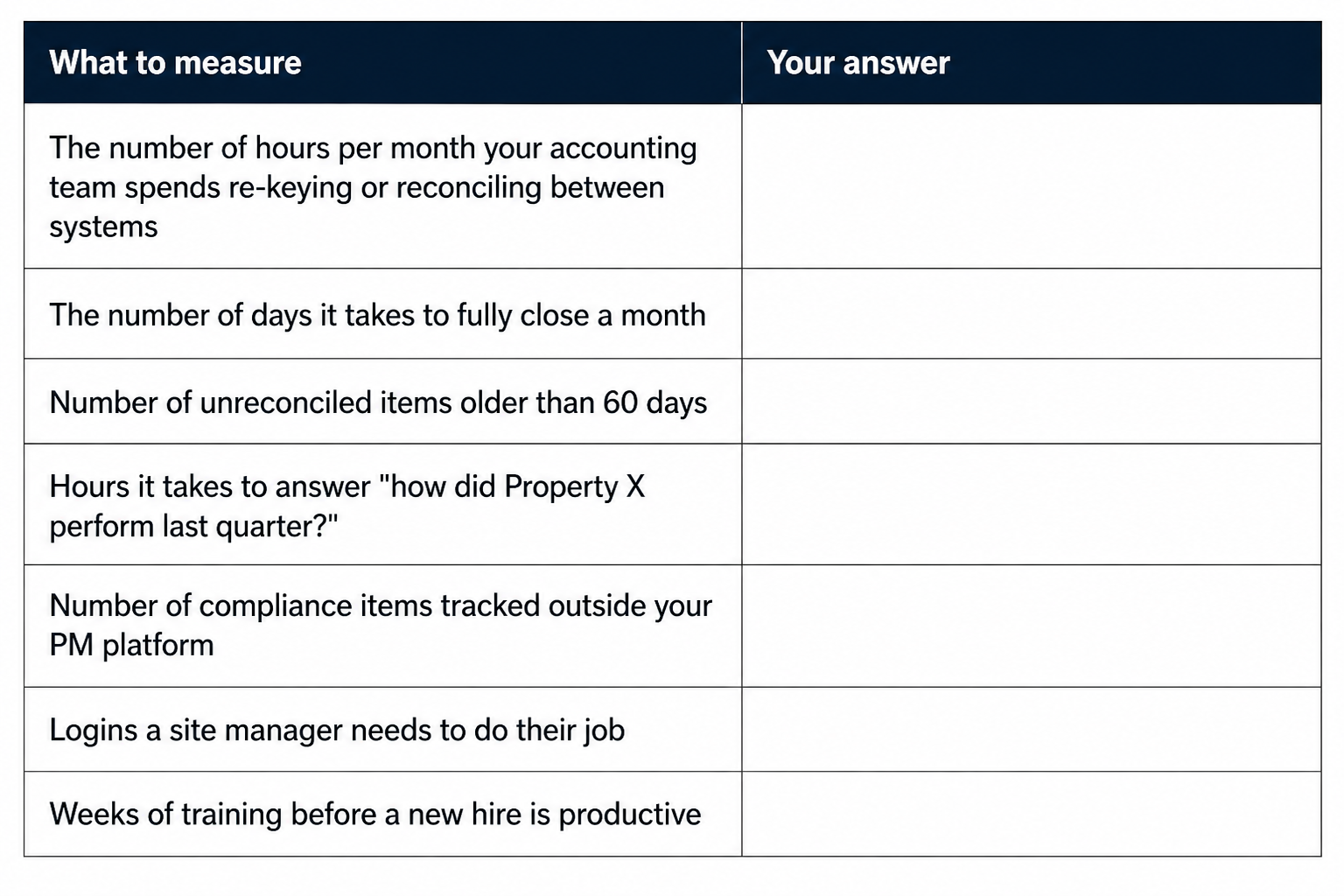
If more than two of those answers make you uncomfortable, you're paying the fragmentation tax. Whether it's worth fixing depends on the next section.
When Fragmentation Is Actually Fine
This is the part most vendors won't tell you: consolidating isn't always the right move.
Sticking with a multi-system stack can make sense when:
- You're under about 50 units, and the volume of cross-system activity is genuinely low.
- You have one specialized need (a specific compliance tool, for instance) that no PM platform handles as well as the point solution you're using — and the integration between them actually works.
- Your accounting team strongly prefers QuickBooks, Sage, or NetSuite for reasons that go beyond the PM side of the business (corporate consolidation, multi-entity tax structure, etc.).
- You've built real custom integrations, and rebuilding them outweighs the cost of maintaining them.
If any of that describes you, fragmentation is a feature, not a bug. Measure the costs, price them against the alternative, and make an honest call.
What a Unified Platform Actually Eliminates
When your PM platform, accounting, compliance, applications, screening, leasing, maintenance, and resident portal live in the same system — sharing the same data model — specific problems go away:
- Auto-journalization. Rent charges, payments, late fees, and subsidy splits create their own GL entries. Nobody retypes them into an accounting system.
- One bank reconciliation. Your operating account reconciles against a ledger that already knows about every transaction, because every transaction was born there.
- Compliance that moves with the lease. A recertification updates the rent, the ledger, the subsidy allocation, and the compliance record in one workflow instead of four.
- Reporting that already joins the data. NOI by property this quarter is one report, not a three-export Excel assembly.
- One login per staff member. One onboarding. One support team. One vendor to call when something isn't working.
This is the case ExactEstate makes — one platform built for affordable housing, multifamily, and HOA operators, with accounting, compliance, TRACS integration, screening, and maintenance in the same system. Flat-rate pricing. U.S.-based support. Live in days, not months. We're also honest that not every organization should consolidate today, and we'll tell you that on a call.
Want to pressure-test your own stack?
The ExactEstate team can walk through the specific numbers for your portfolio on a 30-minute call. No pitch deck. Just the math, the gaps, and an honest answer on whether it's worth moving.
Book a working session → exactestate.com/demo
Frequently Asked Questions
1. Why do property management teams end up using multiple systems?
Most teams don’t plan for fragmentation—it happens over time. As portfolios grow, operators add tools to solve specific gaps (accounting, compliance, maintenance), creating disconnected systems that don’t share data.
2. What are the biggest risks of running multiple property management systems?
The biggest risks are hidden: duplicated data entry, delayed reporting, reconciliation errors, and compliance gaps. In affordable housing, disconnected systems can also lead to audit findings, failed TRACS submissions, and financial penalties.
3. How do fragmented systems impact property management performance?
They slow everything down. Month-end takes longer, reporting becomes reactive instead of proactive, and teams spend more time fixing data instead of making decisions. Over time, this directly impacts NOI and operational efficiency.
4. When does it make sense to keep multiple systems instead of consolidating?
Keeping multiple systems can make sense for smaller portfolios, highly specialized needs, or when strong integrations already exist. The key is whether the operational cost of maintaining them is lower than switching.
5. What does a unified property management platform actually solve?
A unified platform eliminates duplicate work, connects accounting with operations and compliance, and provides real-time reporting. It reduces manual processes, shortens the month-end close, and minimizes compliance risk by keeping everything in one system.