AI for Affordable Housing Compliance: Closing the Audit Gap
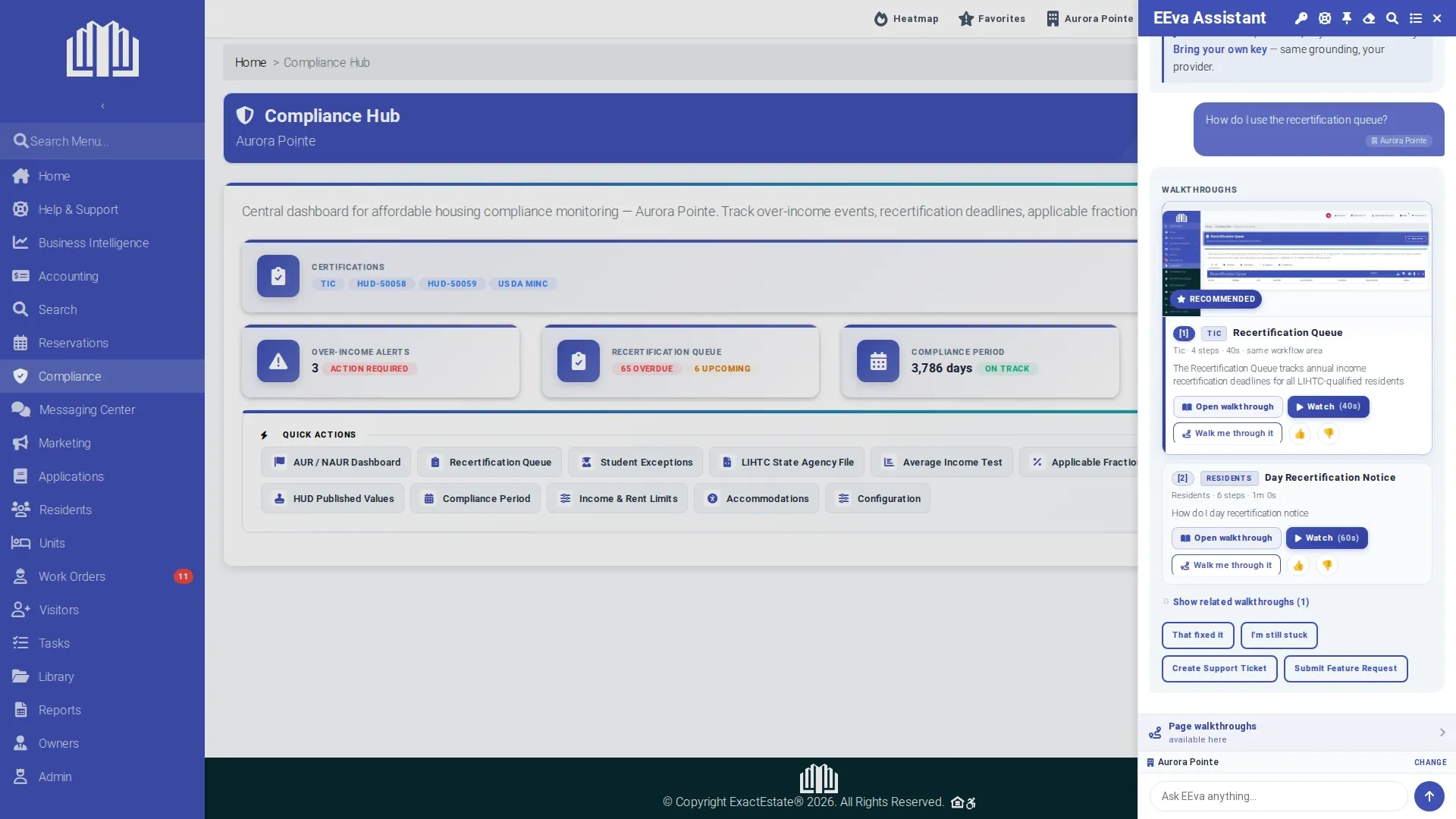
A May 2026 survey of 400 property-management professionals, 162 of them running affordable portfolios, found that 91% of affordable operators have deployed AI somewhere in their operations. The same report describes income certification, recertification, set-aside management, and waitlist administration as still "painstakingly manual, largely pen and paper." AI for affordable housing compliance is the missing piece: the part of the business that fails audits is the part AI never reached, and closing that gap means putting the intelligence inside the system of record instead of bolting a chat window onto the front desk.
The villain is not your team
Nobody chose this split on purpose. Leasing chatbots and maintenance triage were easy to buy because they bolt onto the outside of any property-management system. A vendor can answer "when is the pool open" without ever touching a Tenant Income Certification.
Compliance work is different. A recertification decision depends on the household's income documents, the unit's set-aside, the program layer (real portfolios run LIHTC, Section 8, and HOME on the same unit), the current income limits, and the deadline math on the certification schedule. All of that lives inside the PMS. A bolt-on AI cannot see it, so the bolt-on vendors sold what they could see: the front desk. The compliance office kept its paper binders and its spreadsheet trackers, and 44% of surveyed operators now name compliance and data privacy as their top barrier to going further with AI.
The villain here is the architecture: tools that stopped at the edge of the system of record, and a system of record that never learned to answer questions.
What the manual gap costs
The costs are the ones your board already tracks. Hours of rekey per HAP cycle when subsidy payments are processed by hand. Move-in delays when nothing blocks a unit from leasing before its inspection clears. Audit findings when a reverification is missed because the tracker lived in a spreadsheet - The Cost of Manual Recertifications in Affordable Housing walks through that arithmetic line by line. And on the payments side, processing fees that can run to tens of thousands of dollars a month on a legacy stack. Each of these is a line item, not an abstraction, and each one sits in exactly the workflow the survey says AI has not reached.
What it looks like when the intelligence lives inside the system
ExactEstate's answer is EEva, an assistant built into the property management system rather than bolted onto it. Ask it an affordable-housing program question and it answers from current public authority, with citations, and shows a "What I checked" trail you can open. Ask about your own property while signed in and it works from your programs, documents, and policies, behind a tenant-isolation wall that keeps private data out of public answers. When a question turns out to be a product problem, it becomes a support ticket without leaving the conversation.
The platform underneath it is the reason that works. ExactEstate runs automated TIC and recertifications, HOTMA-ready workflows, and compliance checkpoints that block move-ins until inspections are complete - the mechanics are laid out in How to Automate Income Certification. The results carry numbers: an integrated payments path cuts card-processing cost by up to 97%, and one mid-sized layered LIHTC/Section 8 operator went from $50K to $1.5K a month. The same operator cut hours of manual rekey per HAP cycle to a single bulk subsidy upload. One reviewer on G2, Joe G., put the adoption side plainly: "Implemented in days, not weeks. Runs TRACS submissions." (Reviews are quoted with the attribution their authors published.)
That is the difference between AI as a chat window and AI as a compliance instrument: the second one can be audited, because the evidence trail and the certification data are in the same system.
How to evaluate AI for affordable housing compliance
Three questions separate a defensible tool from a demo:
- Can it cite its sources on a program question, and can you open what it checked? An answer you cannot trace is an answer you cannot put in front of an auditor.
- Does it see your certifications, set-asides, and schedules, or only what a visitor types into a chat box?
- Does it respect the public/private boundary explicitly, so a public visitor can never pull property data?
EEva was built to pass all three. For the broader pre-audit sweep those questions belong to, start from the Affordable Housing Compliance Checklist.
Frequently asked questions
Can AI actually help with LIHTC and Section 8 compliance?
Yes, when it runs inside the system that holds the certification data. Industry survey data from 2026 shows 91% of affordable operators use AI somewhere, while recertifications and set-aside management remain mostly manual because bolt-on tools cannot see the data those workflows need. An assistant embedded in the PMS can answer program questions with citations and work from the portfolio's own certifications.
What should an operator require from an AI assistant before trusting it in an audit context?
Cited public authority for every program answer, a visible record of what the assistant checked, access to the property's real program and certification data when authenticated, and a hard wall that keeps private data out of public answers. If any of the four is missing, the tool is a chat window, not a compliance instrument.
How can you see EEva in action?
Book a live walkthrough from ExactEstate's demo page and ask to see EEva answer a HOTMA question with its "What I checked" trail open. It is the same trail an auditor would ask for.
Sources
- The State of AI in Affordable Housing, survey report, May 7, 2026, EliseAI
- Notice H 2023-10: implementation guidance for HOTMA Sections 102 and 104, HUD
- 26 U.S. Code Section 42, the Low-Income Housing Tax Credit statute, Legal Information Institute, Cornell Law School
Sources
- The State of AI in Affordable Housing, survey report, May 7, 2026 — EliseAI
- Notice H 2023-10: implementation guidance for HOTMA Sections 102 and 104 — U.S. Department of Housing and Urban Development
- 26 U.S. Code § 42, the Low-Income Housing Tax Credit statute — Legal Information Institute, Cornell Law School
What changed
- — Facts, figures and all outbound links re-verified before launch publication
About the author

Matt Hoskins is the CEO of ExactEstate. He grew up in his family’s affordable housing management company and has spent his career on the operator side of LIHTC, HUD and Section 8 properties. ExactEstate is the result: compliance-first property management software for affordable housing, with TRACS submission built in.